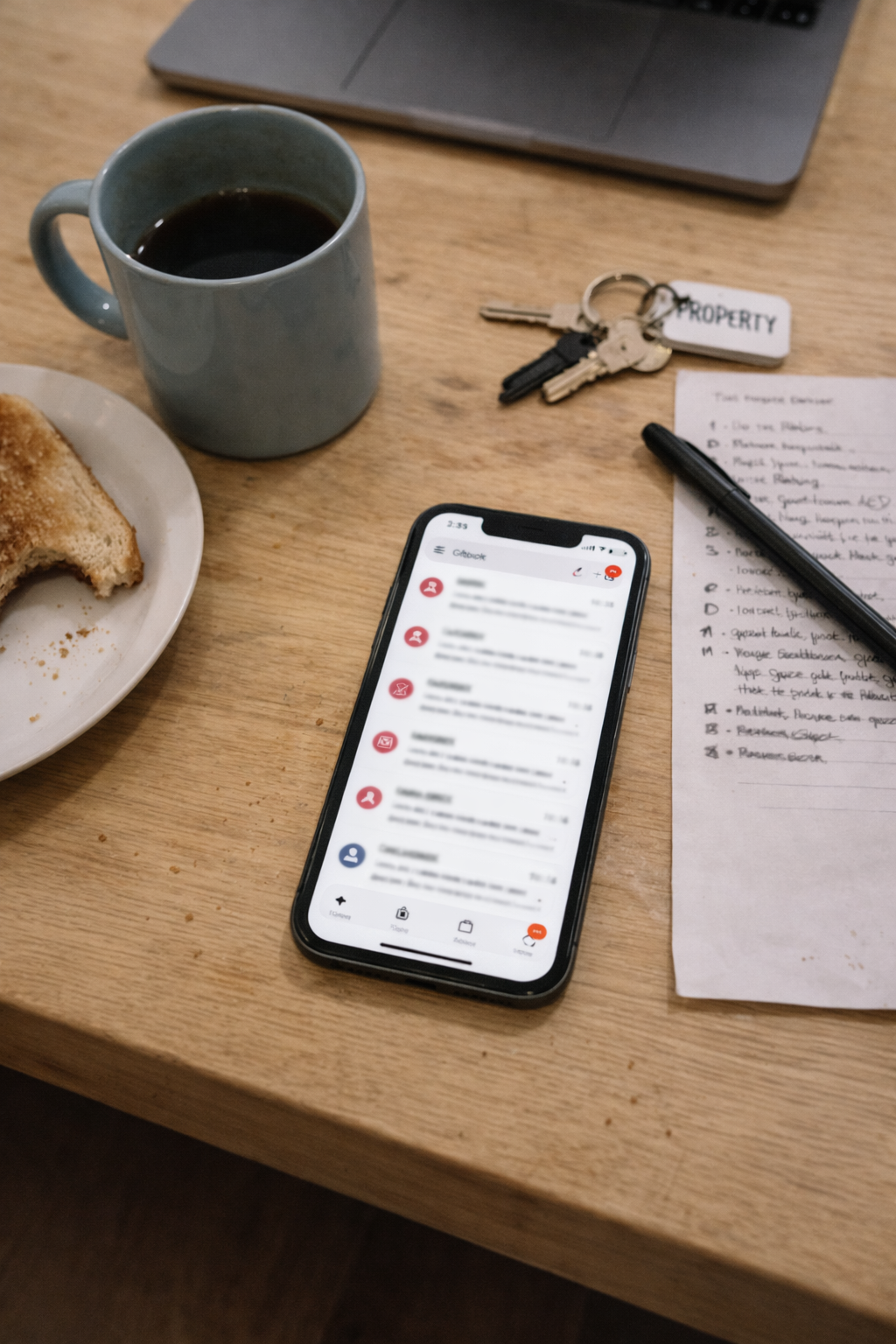
The Questions That Don't Feel Like a Big Deal
Every host gets them. Little questions that take thirty seconds to answer.
"What's the WiFi password?"
"Where's the iron?"
"How do I turn on the hot tub?"
Individually, these are nothing. You tap out a quick reply and move on with your day. No big deal.
But here's the thing about no-big-deals: they add up. And when you actually sit down and count them, the total might surprise you.
Let's Do the Maths
Pull out your phone and look at your recent messages with guests. Pick any booking from the last month.
How many messages did you exchange? I'm not talking about the initial booking inquiry or check-out thanks. I mean the questions during the stay.
For most hosts, it's somewhere between 5 and 15 messages per booking. Sometimes more.
Now multiply that by how many bookings you do per month. Then multiply that by 12.
If you have one property with 20 bookings per month, and each booking generates 8 messages, that's 160 messages per month. Nearly 2,000 messages per year.
Each message might only take 30 seconds to read and reply to. But 2,000 messages at 30 seconds each is over 16 hours per year. That's two full working days spent typing answers to questions like "where do I put the rubbish bins?"
And that's just one property.
The Time Cost Is Just the Beginning
Context Switching Destroys Productivity
Here's what the simple time calculation misses: it's not just 30 seconds.
When you're doing something else - working, cooking dinner, spending time with family - and your phone buzzes with a guest question, you don't just spend 30 seconds answering it.
You have to stop what you're doing. Read the message. Think about the answer. Type it out. Then try to remember what you were doing before.
Studies on workplace productivity suggest that recovering from an interruption takes anywhere from 5 to 25 minutes. Even if we say it only takes 2 minutes to fully refocus after each guest message, those 2,000 messages now represent 66 hours of disrupted time.
That's not nothing.
The Mental Load Is Constant
Even when your phone isn't buzzing, you know it might buzz at any moment. There's a low-level alertness that comes with being constantly available to guests.
You take your phone to the bathroom. You check it during meals. You glance at it before going to sleep and first thing when you wake up. Not because you're addicted to your phone, but because you feel responsible for your guests.
This constant vigilance has a psychological cost. It's low-grade stress that never quite goes away.
The Review Risk You Might Not See
Here's where the hidden costs get really expensive: delayed responses can cost you bookings.
Platforms like Airbnb track your response time. If you consistently take hours to respond (because, say, you were in a meeting, or asleep, or at your kid's football game), your response rate metrics drop.
Lower response metrics can mean:
- Lower search ranking
- Reduced Superhost eligibility
- Fewer booking inquiries
But the more immediate risk is negative reviews.
When a guest texts you with a question and doesn't hear back quickly, they get frustrated. Maybe they figure it out themselves, but they're annoyed. That annoyance might come out as a 4-star rating instead of 5, or a review that mentions "sometimes hard to reach."
One host I talked to had a guest complain in a review that she "took hours to respond" to a question about the air conditioning. The message came through at 3am. The host was asleep. The guest left 4 stars.
That's a real cost that doesn't show up on any spreadsheet.
What About Hiring Help?
If you're thinking "I'll just hire a virtual assistant to handle messages," that's absolutely an option. But let's look at the numbers.
A competent VA might cost $15-25 per hour. If you're paying them to handle 16+ hours of messages per year per property, that's at least $240-400 annually. More if you're paying for 24/7 coverage, which is what you'd need to avoid those slow response times.
For a host with multiple properties, this adds up fast. And you still need to train them, manage them, and handle anything they can't answer.
It works for some hosts, but it's not the magical solution it seems.
What If Questions Answered Themselves?
Here's a different way to think about this problem:
What if most questions never reached you in the first place?
Not because you're ignoring guests, but because they found the answers faster through another channel.
This is the premise behind digital guest guides. Instead of texting you, guests scan a QR code and get instant answers to common questions. The WiFi password, the checkout time, how to work the TV - it's all there, available 24/7.
The result for hosts who implement this properly:
- 60-70% fewer routine messages
- No middle-of-the-night disruptions
- Better response metrics (because there are fewer messages to respond to)
- Guests who feel well-supported because they get instant answers
Calculating Your Personal ROI
Let's make this concrete with your situation.
Step 1: Count Your Messages
Look at your last 5 bookings. Count the guest messages during each stay (not booking inquiries or final thank-yous). Average them.
Step 2: Annualise It
Multiply by your bookings per year.
Step 3: Calculate Time
Multiply by 2 minutes per message (accounting for context switching). Divide by 60 to get hours.
Step 4: Value Your Time
Pick an hourly rate that makes sense for you. Maybe it's what you earn at your day job. Maybe it's what you'd pay a property manager. Multiply your hours by that rate.
For most hosts, this calculation lands somewhere between $500 and $2,000 per year, per property, in time value.
That doesn't include the stress, the disrupted sleep, or the review risk. Just the time.
The Questions You Actually Need to Answer
Not every message can be automated or pre-answered. Some things genuinely require human judgment:
- Early check-in requests
- Special circumstances
- Complaints or problems
- Genuine emergencies
These represent maybe 10-20% of guest messages. They require your attention, your judgement, and often your hospitality.
The other 80%? "Where's the iron?" "What's the WiFi password?" "How do I work the thermostat?"
These don't require human judgment. They just need a quick, accurate answer. There's no reason you need to personally type that answer every single time.
Making the Shift
Reducing your question load doesn't require a complete overhaul of how you host. It starts with understanding what guests actually ask.
Go through your messages. Tally up the questions. You'll likely find that 10-15 questions account for the vast majority of messages.
Those are your targets. Make those answers impossible to miss:
- Put them in a digital guide accessible via QR code
- Print the WiFi password in a frame by the TV
- Label the thermostat controls
- Create a simple appliance cheat sheet
Every question you pre-answer is a future message you won't receive.
The Bigger Picture
Hosting should be profitable, but it should also be sustainable.
Many hosts start out enthusiastic, respond to every message within minutes, and provide incredible service. Then, a year or two in, they're burned out. The constant drip of guest questions has eroded their energy and enjoyment.
The hosts who stick with this long-term aren't the ones who personally answer every question. They're the ones who build systems that provide great guest experiences without requiring their constant attention.
Those 2am WiFi password questions? They're not just costing you 30 seconds of sleep. They're costing you your enthusiasm for hosting.
That's a cost worth addressing.
Ready to stop answering the same questions?
Set up your property in under 10 minutes. Guests scan, ask questions, get instant answers.
Start Your Free Trial