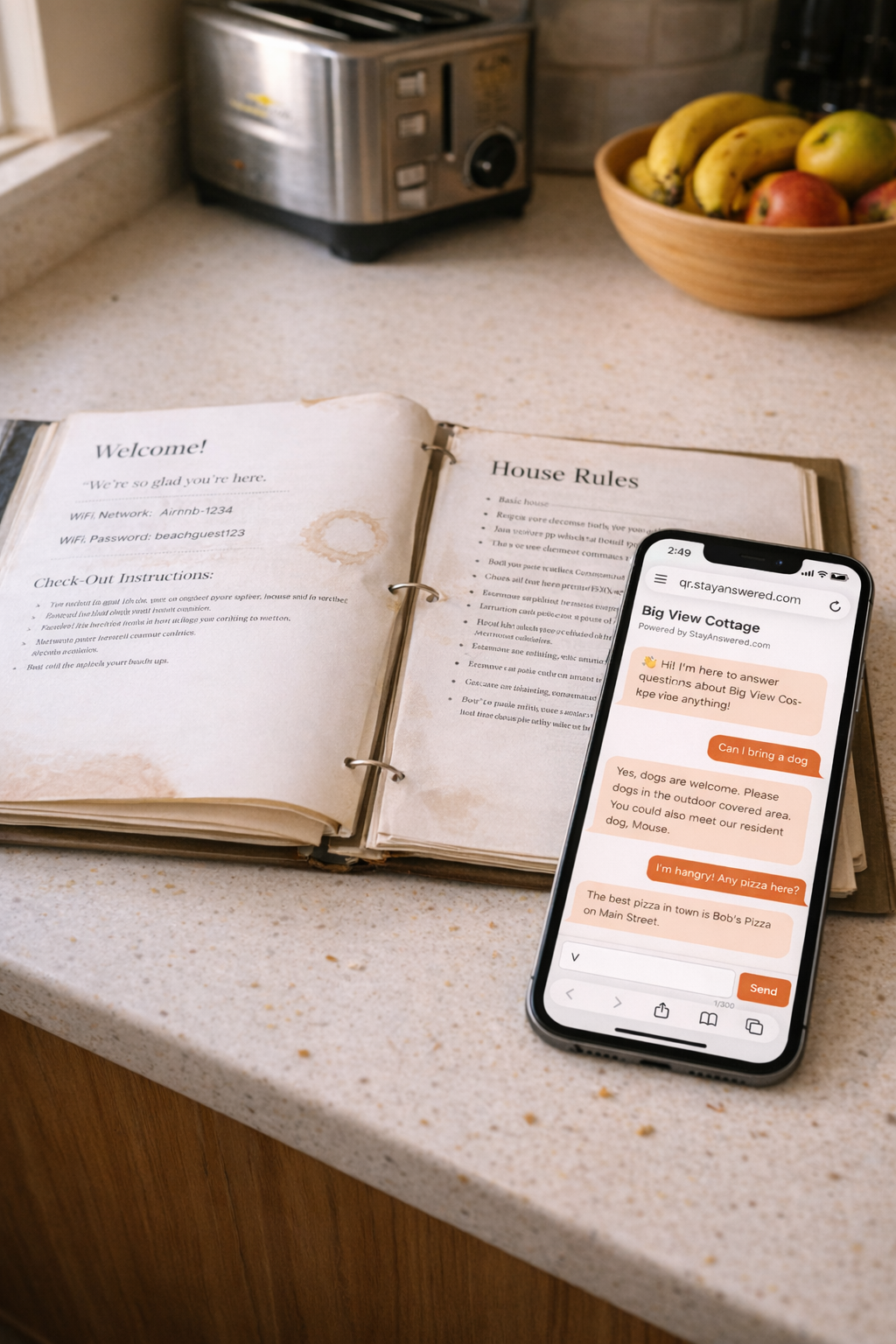
The Welcome Book Problem Every Host Knows
Let me paint a picture you'll probably recognise.
You spent hours putting together a beautiful welcome book. You printed it on nice paper, slid it into a leather binder, and placed it prominently on the kitchen counter. It has everything: Wi-Fi password, checkout instructions, where to find extra blankets, local restaurant recommendations, and even that finicky trick for getting the shower to the right temperature.
Then your first guest checks in. You watch the Ring camera as they walk past the welcome book, toss their bags on the couch, and immediately text you: "What's the Wi-Fi password?"
Sound familiar? You're not alone. This happens in rentals everywhere, every single day.
Why Paper Welcome Books Fail
Guests Don't Read Manuals on Holiday
Here's the uncomfortable truth: people on holiday don't want to study. They've just traveled for hours, they're tired, and the last thing they want to do is read through 30 pages of house instructions.
A paper welcome book is essentially a user manual. And when was the last time you read a user manual cover to cover? Most of us skim until we find what we need, then give up when it's not immediately obvious.
Information Overload Causes Shutdown
The typical welcome book tries to anticipate every possible question. WiFi, parking, heating, cooling, appliances, house rules, local tips, emergency contacts... it goes on and on.
The problem is, guests don't have every question at once. They have one question at a time. When they need to know how to work the coffee machine, they don't want to flip through pages about the hot tub and recycling bins to find it.
So what do they do? They text you instead. It's faster.
Paper Can't Be Updated Easily
Your Netflix password changed. You added a new smart lock code. That great pizza place closed down. The garbage collection day moved to Tuesday.
With a paper book, each update means reprinting pages or scribbling notes in margins. Eventually the book becomes a mess of outdated information and handwritten corrections. Guests start to distrust it, so they text you to confirm things "just in case."
Location, Location, Location
A paper book lives in one spot. But guests have questions everywhere. They're standing in the laundry wondering how to start the dryer. They're in the bathroom looking for the light switch. They're in the bedroom trying to figure out the air conditioning remote.
The welcome book is back on the kitchen counter, completely useless.
The Digital Alternative
Digital guidebooks flip everything around. Instead of expecting guests to come to the information, you bring the information to the guests.
Here's what changes:
Questions Instead of Chapters
With a digital guidebook, guests don't browse through categories. They just ask their question: "How do I work the coffee machine?" and get a direct answer.
No flipping pages. No table of contents. No hunting. Just the answer they need, right now.
Available Everywhere via QR Code
A QR code can be placed anywhere. Stick one by the coffee machine. One by the thermostat. One by the TV. One by the pool controls. Wherever a guest might have a question, the answer is a quick scan away.
They don't need to download an app. They don't need to create an account. They just point their phone camera at the code and start asking questions.
Always Current, Always Accurate
When something changes, you update it once and it's updated for every guest from that moment on. No reprinting. No crossed-out text. No "actually, ignore what the book says" messages.
Guests learn to trust the information because it's always right.
Works at 2am When You're Asleep
This is the big one.
Your paper welcome book can't answer questions at 2am. But your guests definitely have questions at 2am. They can't figure out how to turn off the porch light. They want to know if they can adjust the heating. They're looking for extra pillows.
With a digital guidebook, they get answers instantly, no matter what time it is. You stay asleep. They stay happy. Everyone wins.
Real Results from Real Hosts
Hosts who switch from paper to digital consistently report:
- 60-70% fewer guest messages about routine questions
- Faster response satisfaction because guests get instant answers
- Better reviews mentioning how "easy" and "well-organised" the stay was
- Less stress because they're not constantly checking their phone
One host told me she used to dread Friday evening check-ins because she knew her phone would be buzzing all night. After switching to a QR-based digital guide, she said the silence was "almost eerie" at first. Then it just became normal.
Making the Switch
If you're convinced that digital is the way forward, here's how to think about the transition:
Start with your most common questions. Look through your message history. What do guests ask most often? WiFi password, checkout time, how to work the TV? Those are your priority items.
Don't try to replace everything at once. Your paper book probably has 50+ topics. Start with 20. You can always add more later.
Keep the paper book as backup. Some guests prefer paper. Some might have phone issues. Having both options doesn't hurt.
Put QR codes where questions happen. A single code on the fridge is better than nothing, but multiple codes throughout the property is better.
The Bottom Line
Paper welcome books aren't bad. They're just not how modern guests prefer to get information. We're all used to searching for what we need and getting instant answers. A 30-page binder feels like homework.
Digital guidebooks work because they match how people actually behave. Quick questions, instant answers, no friction.
Your guests will thank you. Your sleep schedule will thank you even more.
Ready to stop answering the same questions?
Set up your property in under 10 minutes. Guests scan, ask questions, get instant answers.
Start Your Free Trial